The 7-10 day monthly close was designed for a different finance function. It assumed paper ledgers, quarterly reporting cycles, and a board that could wait two weeks for last month's numbers. None of those conditions apply to a mid-market company in 2026. Boards want monthly numbers within days. CFOs need real-time visibility to defend pricing, cash, and headcount decisions. And the close itself — the mechanical reconciliation, intercompany elimination, and variance commentary — is the single largest predictable workload the finance team carries every month.
Continuous close, enabled by agentic AI, removes most of that workload. Mid-market teams that previously closed in seven to ten business days are now closing in one to two, with reconciliation running continuously through the month rather than crystallising at the end. The mechanics are no longer experimental. The 90-day path is well understood.
Why the traditional close cycle is breaking
The classical close timeline absorbs four kinds of work, in this order:
- Cut-off and accruals. Days 1-2 — making sure every transaction lands in the right period.
- Reconciliations. Days 2-5 — bank, AP, AR, intercompany, payroll, fixed assets.
- Adjustments and review. Days 4-7 — journal entries, manager review, controller sign-off.
- Reporting and commentary. Days 6-10 — close pack assembly, variance narratives, board materials.
Each of these steps was designed to be executed by a human. Each is now executable, in large part, by an agent. According to industry benchmarks compiled by close-automation research, best-in-class mid-market teams now report 75-90% reductions in mechanical close work, close cycles compressing to one to two business days across revenue bands from $10 million to $250 million-plus, and 32-50% faster close timelines in third-party studies of AI-augmented finance teams.
The board pressure is the practical accelerator. In a 2025 mid-market CFO survey by Cherry Bekaert, 49% of finance leaders reported that poor data quality blocks them from making critical decisions in time. Continuous close is not a vanity metric. It is the operational foundation of decision velocity.
What continuous close actually means
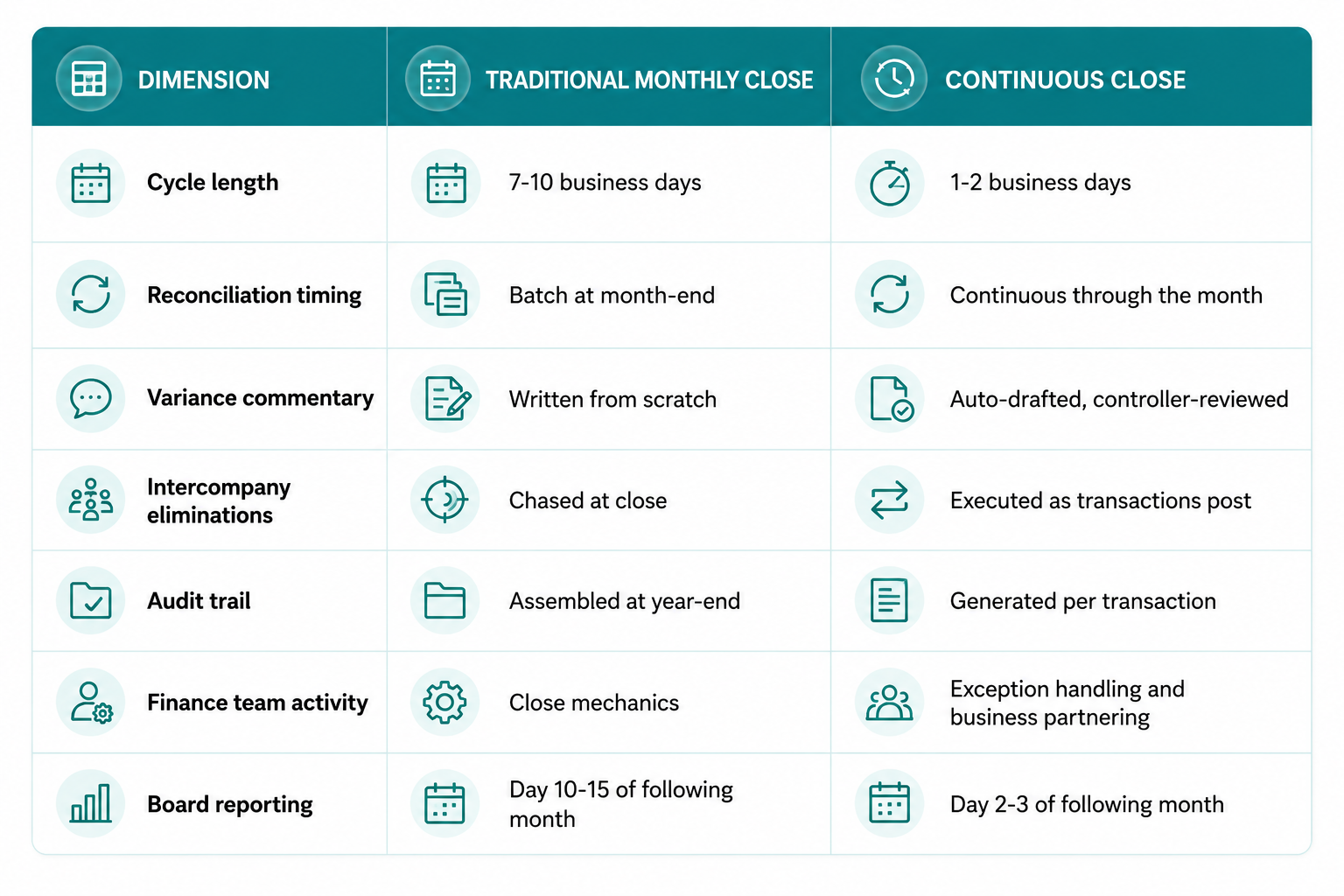
Continuous close does not mean closing every day. It means the work that historically happened in the first ten business days of the month happens continuously through the month, so that the close cycle itself collapses to one or two days of review and sign-off.
The mechanical shifts are specific:
- Reconciliations move from days to minutes. Bank, AP, AR, and intercompany reconciliations run continuously as transactions clear, not in a batch at month-end. AI agents match transactions, flag breaks, and route only the genuine exceptions to a human.
- Variance narratives are auto-drafted. The Analytics Agent reads the close data, generates first-pass variance commentary against budget and prior period, and hands it to the controller for review rather than authorship.
- Intercompany eliminations execute by agent. Transactions are paired and eliminated in real time as they post, not at the end of the month when finance has to chase them across legal entities.
- Audit trails generate continuously. Every executed decision — every match, every accrual, every adjustment — carries a reasoning trail logged at the moment of action. Audit prep, internal and external, becomes a query rather than an assembly project.
The reporting layer changes too. Close packs are no longer assembled at day seven; they exist continuously and are signed off at day one or two.
Reactive close vs. continuous close
The 90-day plan to compress close from 7+ days to under 3
The practical sequence for a mid-market team running a Stage 2 or Stage 3 close — cloud ERP in place, dashboards live, mechanical work still manual — typically lands in three phases over 90 days.
Days 1-30: Deploy continuous reconciliation on AP and bank
Connect the agentic platform to the ERP. Deploy the AP Agent to handle invoice matching, three-way reconciliation against purchase orders, and GL posting. Deploy bank reconciliation agents against the primary operating accounts. Target outcome: AP reconciliation moves from a day-three close task to a continuous background process. Expected close compression: 1-2 days.
Days 31-60: Layer policy enforcement and expense automation
Deploy the Policy Agent across corporate cards and (in India) UPI wallets, with pre-transaction enforcement on submission. Deploy the Expense Agent for zero-touch reimbursement processing. Target outcome: month-end policy adjudication and expense reconciliation collapse. Expected close compression: another 1-2 days.
Days 61-90: Deploy the Analytics Agent for variance and reporting
Layer the Analytics Agent (FinPilot) for auto-drafted variance commentary, real-time spend visibility, and natural-language query across the close data. Target outcome: close pack assembly is continuous rather than end-of-month. Expected close cycle by day 90: 1-2 business days, trending toward continuous.
The dollar logic of compressed close
For a $50 million-revenue mid-market company with a six-person finance team, a 7-day close absorbs roughly 250-300 finance team hours per month across reconciliations, adjustments, reviews, and reporting. At a fully-loaded $80,000 per FTE, that is approximately $115,000-$140,000 annually in close-mechanic labor.
A 1-2 day continuous close typically reclaims 70-80% of that — $80,000-$110,000 in annual labor that redeploys to FP&A, business partnering, and analytical work. Add the secondary effects: reduced audit-prep costs ($20,000-$40,000), reduced overage fees, and the decision-velocity gain from real-time numbers (hard to dollarise but consistently cited as the largest benefit by CFOs who have made the move).
For the ₹400 crore-revenue Indian mid-market analogue, the labor recovery typically lands between ₹50 lakh and ₹80 lakh annually, plus the statutory and GST cycle gains from continuous audit trails.
How TERA helps with continuous close
TERA's four agents are designed to absorb the work that traditionally lives inside a month-end close. The AP Agent and Analytics Agent (FinPilot) handle the largest two work streams; the Policy Agent and Expense Agent remove the policy and reimbursement work that typically lands on the close team at month-end.
What that looks like in practice:
- Continuous AP reconciliation. Invoices matched, paid, and posted to the GL throughout the month — no batch close task.
- Continuous anomaly detection. Duplicates, unusual vendor patterns, and budget breaks flagged in real time across the entire transaction base.
- Auto-drafted variance commentary. The Analytics Agent generates first-pass narrative against budget and prior period; controllers review rather than author.
- Continuous audit trail. Every agent action carries reasoning. Audit prep becomes a query.
- Real-time close visibility. Where the close stands at any moment — open items, exceptions, sign-offs pending — is visible without a status meeting.
Try a demo to see how TERA's agents compress a 7-day close to 1-2 days within 90 days, and what continuous close looks like in your specific ERP.
Frequently asked questions
What is continuous close?
Continuous close is a finance operating model in which the mechanical work of monthly close — reconciliations, eliminations, accruals, variance analysis — runs continuously through the month rather than crystallising in the first 7-10 business days of the following month. The close cycle itself compresses to 1-2 days of review and sign-off.
How fast can a mid-market company actually close with AI agents?
Industry benchmarks place best-in-class AI-augmented close at 1-2 business days for mid-market companies across revenue bands from $10 million to $250 million-plus. Third-party studies cite 32-50% faster close cycles after agentic deployment.
How long does it take to move from a 7-day close to a 1-2 day close?
The standard mid-market plan is 90 days, sequenced across AP reconciliation, policy and expense automation, then analytics. Most teams see the first 1-2 day compression by day 30 and reach a 1-2 day close by day 90.
Does continuous close apply to Indian finance teams?
Yes. The architectural pattern is jurisdiction-agnostic. The India-specific dimensions are GST cycle reconciliation, Ind AS-compliant journal entries, and statutory audit prep — all of which benefit from continuous audit trails generated per transaction.
Does continuous close replace the controller?
No. It changes what the controller does. Mechanical reconciliation and assembly work move to agents. The controller's role shifts to exception handling, governance, sign-off, and business partnering — the work most controllers say they were hired to do but never had time for.
What is the biggest blocker to continuous close?
Typically not technology. The blockers are operating model — redesigning close roles around exception management — and data hygiene in the ERP that the close depends on. Both are solvable in 90 days for most mid-market profiles.
Case study — Divay Hygiene
10× faster monthly close
Divay Hygiene's finance team was running a seven-day close on a cloud ERP, with reconciliations breaking between AP, expense, and the GL each month. Variance commentary was written from scratch. Board reporting landed in the second week of the following month.
- TERA's AP Agent ran continuous reconciliation against the ERP and posted GL entries through the month
- TERA's Analytics Agent auto-drafted variance commentary and surfaced anomalies in real time
- TERA's Policy Agent enforced spend rules pre-submission, eliminating month-end policy adjudication
- Monthly close compressed from seven business days to real-time visibility; the finance team redeployed to FP&A and business partnering
About TERA
TERA is the AI-native spend intelligence and finance automation platform built for the mid-market. Through agentic AI, TERA executes the work that finance teams have historically managed by hand — expense processing, accounts payable, policy enforcement, and spend analytics — moving organisations from reactive finance, through proactive control, to fully autonomous operations.
Trusted by growing companies across healthcare, manufacturing, e-commerce, financial services, and logistics, TERA is the command centre for finance teams that want to spend less time on the work and more time on the decisions. Learn more at tera.cloud.
Written by [Author name], [Title at TERA]. Reviewed by [Reviewer name, CPA / CA / former CFO]. TERA is committed to publishing finance content that informs procurement, accounting, and operating decisions for mid-market CFOs. We adhere to strict editorial standards on accuracy, attribution, and independence.