Most finance maturity frameworks were built for a world that no longer exists. They were designed when cloud ERPs were the frontier, dashboards were the upgrade, and "predictive" was the highest aspiration. None of them account for agentic AI — software that does not just forecast or suggest, but executes finance work end-to-end inside governed limits. The CFO question is no longer whether your finance function is mature. It is which stage you are currently in, what it is costing you to stay there, and which technology and skills shift you from stage to stage.
This is a four-stage model built for that question. Use it to diagnose, not to grade.
Why the older maturity frameworks fall short
Classical finance maturity models — Gartner, Hackett, McKinsey, the Big Four variants — typically cap out at "predictive finance": ML-augmented forecasting, anomaly detection, and a copilot layer over the ERP. Stage 4 in those frameworks looks a lot like best practice from 2022.
Agentic AI changes the ceiling. According to Gartner, by 2028 at least 15% of day-to-day work decisions will be made autonomously by agentic AI, up from zero in 2024. According to Deloitte's 2026 finance trends research, 63% of finance teams are already deploying AI in some form. The frontier has moved. So has the cost of staying behind it.
The four stages
Stage 1: Reactive
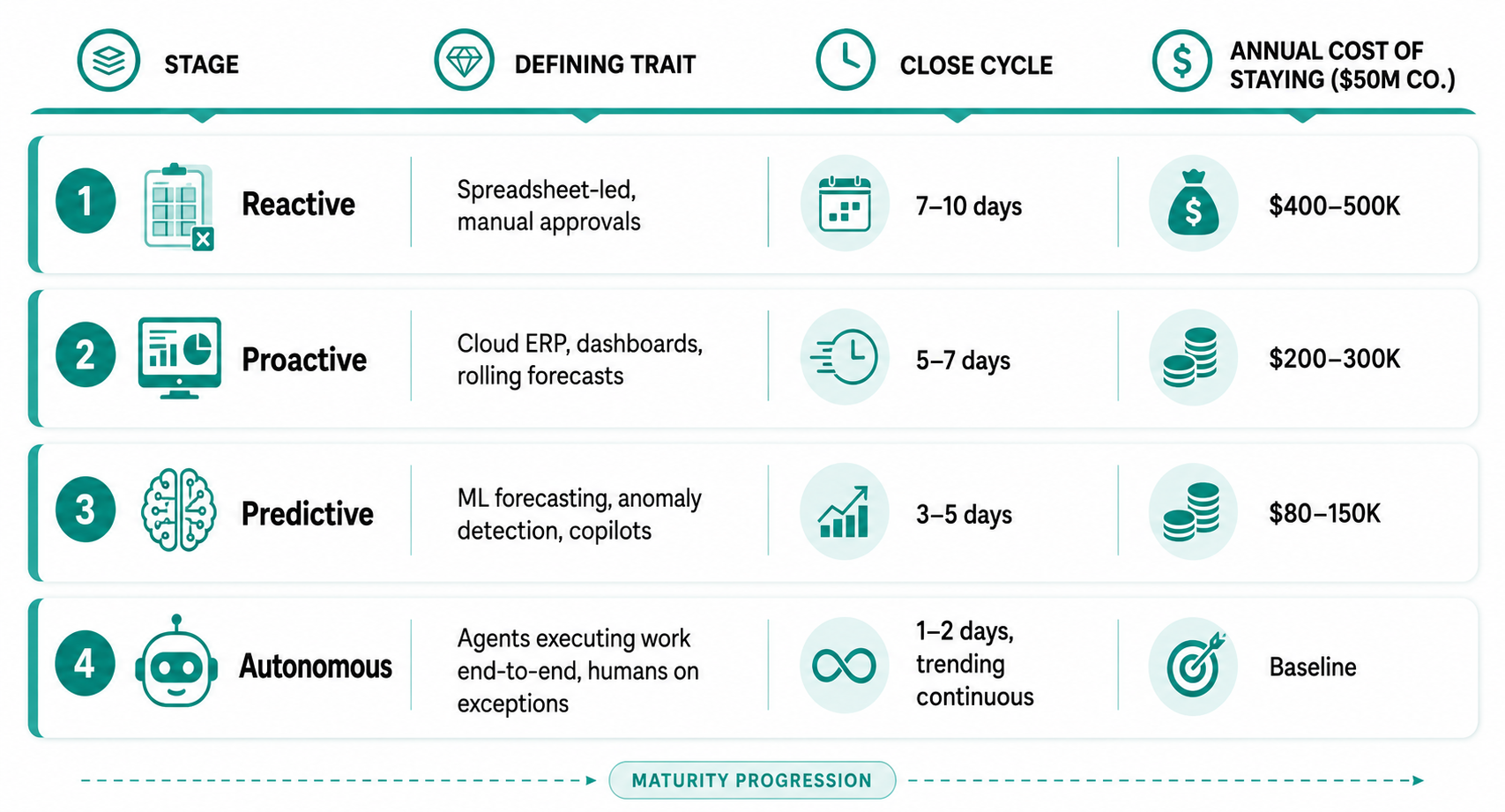
The reactive finance function operates after the fact. Spreadsheets are the system of record outside the ERP. Approvals route through email. Close lands somewhere between days seven and ten of the following month. Variance commentary is hand-written in the close pack. There is no real-time spend visibility — by the time a number is questioned, the spend has already cleared.
Signs you are here:
- Close cycle of 7-10 business days, with the same five reconciliations breaking each month.
- Spreadsheet-led FP&A, where the forecast is a static file refreshed once a month.
- Email-based approval chains that no one can audit without screenshots.
- Vendor master and policy live in different systems, neither of which is the system of truth.
What blocks progression: an ERP that the team has outgrown, headcount that scales with transaction volume rather than analytical work, and a CFO calendar absorbed by close mechanics rather than business decisions.
What it costs: for a $50 million-revenue company, the labor tax, error rework, missed early-pay discounts, and decision lag of reactive finance run to roughly $400,000-$500,000 annually — close to 1% of revenue.
Stage 2: Proactive
Proactive finance has moved off spreadsheets and onto a cloud ERP. Dashboards refresh nightly. Rolling forecasts replace static budgets. Approvals route through workflow rules. Close lands at days five to seven. The team has visibility — but visibility is still a backward-looking concept, and execution still requires a human at every step.
Signs you are here:
- Cloud ERP deployed (NetSuite, Sage Intacct, Microsoft Dynamics, Oracle Fusion, or similar).
- Dashboards for AP, AR, expense, and spend, but every workflow ends with a manual click.
- Rolling 13-week forecast updated weekly by an FP&A analyst.
- Defined spend policy enforced through review, not through controls.
What blocks progression: the assumption that more dashboards equal better decisions. They do not. They equal more inputs to the same human bottleneck.
What it costs: $200,000-$300,000 a year in residual labor and process inefficiency, mostly concentrated in AP cycle time, expense reimbursement turnaround, and missed early-pay discount capture.
Stage 3: Predictive
Predictive finance has layered machine learning over the cloud ERP. Forecasts incorporate historical patterns and external signals. Anomaly detection flags unusual invoices. A copilot inside the close software drafts variance narratives. Close compresses to three to five days. This was the maturity frontier two years ago. It is now the entry ticket.
Signs you are here:
- ML-augmented forecasting running against the cloud ERP.
- AI copilots in the workflow — Microsoft 365 Copilot for Finance, ERP-native conversational layers, FP&A copilots inside DataRails or Cube.
- Anomaly detection on transactions, surfacing exceptions rather than waiting for month-end review.
- Self-service analytics for business partners, reducing ad-hoc requests on the finance team.
What blocks progression: copilots stop at recommendations. Every flagged invoice, every suggested journal entry, every variance narrative still requires a human to read, decide, and click. Volume of work moves down. Volume of clicks does not.
What it costs: $80,000-$150,000 a year, mostly in the residual human-in-the-loop tax on routine transactional work.
Stage 4: Autonomous
Autonomous finance moves from suggestion to execution. Within governed limits — policy thresholds, approval rules, role-based access — AI agents complete the work. Invoices are captured, matched, approved, paid, and posted to the GL without a human touch on standard cases. Out-of-policy spend is rejected at the point of swipe. Anomaly detection is continuous, not weekly. Close compresses toward one to two days and trends toward continuous. Humans handle exceptions and set policy. The finance team's day looks fundamentally different.
Signs you are here:
- Agentic execution on AP, expense, and policy — humans involved only on exceptions.
- Pre-transaction policy enforcement on cards and corporate wallets, not month-end reconciliation.
- Continuous reconciliation, with close compressing to one to two days.
- Auditable agent reasoning on every executed decision, role-based controls, configurable kill switches.
What blocks progression: typically not technology. It is operating model — the redesign of finance roles around exception management, governance, and analytical work, rather than routine execution.
How to diagnose your stage
The most useful self-assessment is operational, not technological. Three questions reliably place a finance function on the model:
- How many business days does your monthly close take? Ten or more is Stage 1. Five to seven is Stage 2. Three to five is Stage 3. One to two, trending continuous, is Stage 4.
- What proportion of AP invoices reach the GL without a human touch? Below 10% is Stage 1 or 2. 20-50% is Stage 3. 70-90% is Stage 4.
- When is spend policy enforced? At month-end reconciliation is Stage 1-2. At approval review is Stage 3. At the point of swipe or submission is Stage 4.
Most mid-market finance functions land between Stage 2 and Stage 3 today. The gap to Stage 4 is no longer a technology question. It is a sequencing question — which agent to deploy first, which process to govern, which roles to reshape.
The dollar logic of moving up
For a $50 million-revenue mid-market company, the practical economics of each stage transition:
- Stage 1 to Stage 2: typically a $100,000-$200,000 annual ERP investment, recovering $150,000-$250,000 in residual manual cost. Pay-back in 12-18 months. Often funded as part of a broader ERP modernisation.
- Stage 2 to Stage 3: a $40,000-$80,000 annual copilot and ML-forecasting investment, recovering $100,000-$150,000 in faster analytical cycles. Pay-back in 6-12 months.
- Stage 3 to Stage 4: a $60,000-$120,000 annual agentic platform investment, recovering $200,000-$300,000 in execution labor, error reduction, and discount capture. Pay-back in 6-8 months.
The compounding insight: the higher the stage, the faster the pay-back on the next move. The cost of staying in Stage 1 dwarfs the cost of getting to Stage 4.
How TERA helps mid-market teams compress the journey
TERA is built as a Stage 4 platform. The four agents — Expense Agent, AP Agent, Analytics Agent (FinPilot), and Policy Agent — are designed to execute routine work end-to-end inside governed limits, with humans handling exceptions. The platform does not require a Stage 3 starting point. Mid-market teams routinely move from Stage 2 directly to Stage 4 by sequencing the agents thoughtfully.
What that path typically looks like:
- Month 1-2: deploy the AP Agent against the existing cloud ERP. Invoice processing labor drops 60-80%.
- Month 2-3: deploy the Expense Agent and Policy Agent together. Reimbursement turnaround collapses from days to minutes. Pre-transaction enforcement removes the bulk of audit-prep work.
- Month 3-4: layer the Analytics Agent (FinPilot) for real-time spend visibility and natural-language query. Decision lag closes.
- Month 4-6: close cycle compresses to three days, trending toward one to two.
For the Indian mid-market, the same sequence applies with one local variant: the AP Agent and Policy Agent run natively against corporate UPI wallets, which is where most legacy spend platforms struggle with India's vendor acceptance footprint.
Try a demo to see where your finance function sits on the model and what a 90-day path to Stage 4 looks like for your specific stack.
Frequently asked questions
What is a finance maturity model?
A finance maturity model is a structured framework for diagnosing how mature a finance function is — typically across dimensions like close speed, automation depth, decision velocity, and technology stack. The four-stage model in this article (Reactive, Proactive, Predictive, Autonomous) is adapted for the agentic-AI era.
What stage are most mid-market finance functions in today?
Most mid-market finance functions sit between Stage 2 (Proactive) and Stage 3 (Predictive). They have a cloud ERP and dashboards, may have early ML or copilot adoption, but still require human execution on the bulk of routine transactional work.
Can a finance team skip from Stage 2 to Stage 4 directly?
Yes, and it is increasingly common. Agentic platforms do not require a Stage 3 predictive foundation. Mid-market teams typically deploy agents in sequence — AP first, then expense and policy, then analytics — and reach Stage 4 within four to six months.
How long does it take to move from Stage 3 to Stage 4?
Typically four to six months for a mid-market deployment, with pay-back on the agentic platform investment landing between months six and eight on Year 1 recovery alone.
Does the model apply to Indian mid-market companies?
Yes. The stage definitions are operating-model concepts, not jurisdiction-specific. The India-specific variant is that Stage 4 platforms must natively support corporate UPI wallets, GST cycles, and Ind AS-compliant journal entries — a gap that India-native agentic platforms close.
What is the most common reason finance teams stall at Stage 2 or 3?
The assumption that the next move is technological when it is operating-model. Teams add dashboards and copilots without redesigning the roles those tools are meant to replace, and the human bottleneck stays in place.
Case study — Divay Hygiene
10× faster monthly close
Divay Hygiene's finance team was running a typical Stage 2 close: cloud ERP in place, dashboards live, but close mechanics stretched across seven business days each month with reconciliations breaking down between AP, expense, and the GL.
- TERA's AP Agent matched invoices to purchase orders and posted to the GL without manual intervention on standard cases
- TERA's Analytics Agent ran continuous reconciliation and surfaced anomalies in real time, not at month-end
- TERA's Policy Agent enforced spend rules pre-submission, eliminating the bulk of audit-prep work
- Monthly close compressed from seven days to real-time visibility, with the finance team shifting to exception handling and business partnering
[Client quote from Divay Hygiene finance leadership — to be inserted.]
About TERA
TERA is the AI-native spend intelligence and finance automation platform built for the mid-market. Through agentic AI, TERA executes the work that finance teams have historically managed by hand — expense processing, accounts payable, policy enforcement, and spend analytics — moving organisations from reactive finance, through proactive control, to fully autonomous operations.
Trusted by growing companies across healthcare, manufacturing, e-commerce, financial services, and logistics, TERA is the command centre for finance teams that want to spend less time on the work and more time on the decisions. Learn more at tera.cloud.
Written by [Author name], [Title at TERA]. Reviewed by [Reviewer name, CPA / CA / former CFO]. TERA is committed to publishing finance content that informs procurement, accounting, and operating decisions for mid-market CFOs. We adhere to strict editorial standards on accuracy, attribution, and independence.